.jpg)
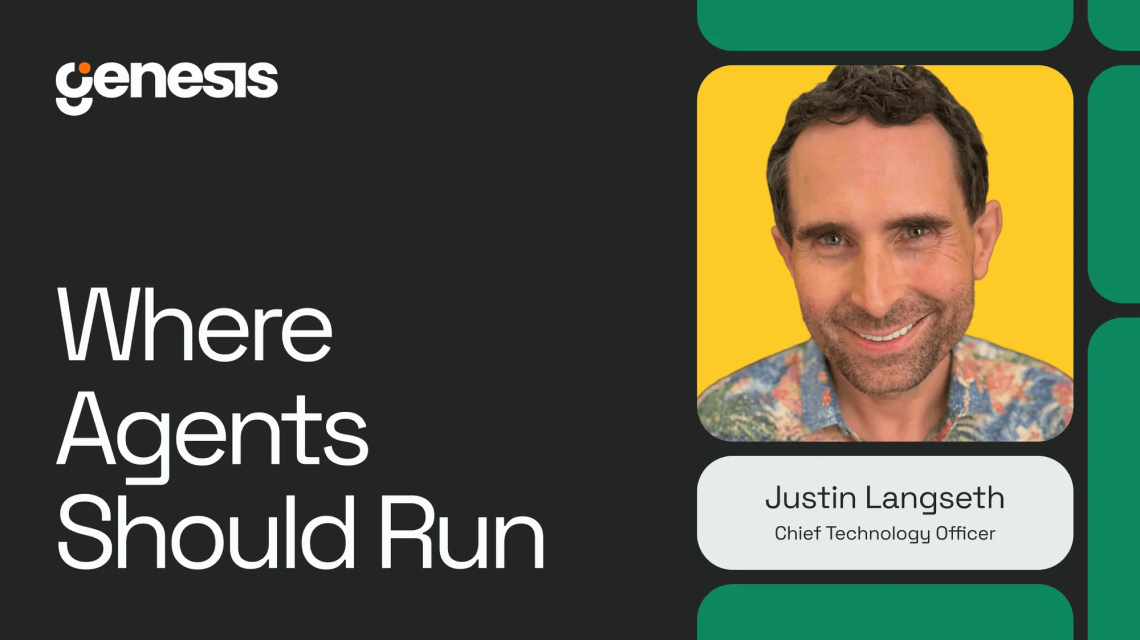
Justin Langseth
Chief Technology Officer
LinkedIn
At Snowflake, Justin helped launch the data marketplace and worked on the AI strategy. Before that, he co-founded and led several companies, including Zoomdata and Clarabridge. He holds 51 technology patents related to data sharing, protection, and analysis. He graduated from MIT with a degree in Management of Information Technology.
Back to BLOG
%201%20(1).jpg)

.jpg)
.png)
.jpg)
.png)
.png)
.png)
.png)



.png)
.png)
.jpg)
%201%20(1).jpg)
Stay in the Fast Lane
News and product updates in Agentic AI for enterprise data teams.
Oops! Something went wrong while submitting the form.

Back to top
share
In this demo, we explore how Genesis works alongside a coding agent, Cortex Code (Coco), to assign work, monitor execution, evaluate outcomes, and guide next steps. The result is a coordinated, multi-agent workflow where higher-level intelligence directs hands-on implementation.
Step 1: Assigning and Monitoring Work
We begin with Eve, a Genesis agent, introducing herself to Coco and assigning a simple task: run a SQL query and retrieve baseball-related data from Snowflake.
On one side of the screen, we see the live session log where Eve communicates instructions. On the other, Coco executes commands directly in Snowflake. As Coco works, Eve monitors progress in real time, ready to intervene if needed.
Coco retrieves the data and summarizes the results. Eve validates the outcome and provides a high-level recap of what was completed. From there, Eve continues the conversation thread and asks a follow-up question: how many players are in the dataset?
Because the session context is preserved, Coco does not need to repeat prior work. It simply builds on what has already been done and returns the answer, 18,000 players.
At any moment, a human can step in, redirect the agents, or take control of the session. Genesis is built for collaboration between AI agents and human oversight.
Parallel Execution
Next, Eve assigns multiple tasks in parallel. Coco is instructed to generate separate datasets for different animals.
Immediately, we see multiple independent sessions running simultaneously. Each task operates asynchronously, while Eve maintains oversight across all of them.
If adjustments are needed, either Eve or a human can intervene. For example, changing one task from rabbits to turtles mid-execution. The agents adapt and continue.
Once all sessions complete, Eve confirms that each dataset has been successfully created.
These examples are simple, but they illustrate a core capability: structured delegation, parallel execution, and continuous supervision.
The Bigger Question:
How Do You Define the Right Work?
Assigning tasks is easy. The real challenge is deciding what work should be done in the first place.
This is where Genesis operates at a higher level.
Genesis maintains a live context graph of the entire data ecosystem. Not just Snowflake, but also surrounding systems such as MuleSoft, Kafka, Informatica, Oracle, and other enterprise tools.
Rather than focusing only on what happens inside the warehouse, Genesis understands how data flows across the organization. It builds a digital twin of the ecosystem and continuously analyzes it.
This broader visibility allows Genesis to identify:
- Cost-saving opportunities
- Performance optimizations
- Architectural improvements
- Data quality enhancements
- New feature initiatives
Blueprint-Driven Brainstorming
Genesis includes a structured methodology called the Project Brainstorming Blueprint.
This blueprint follows four phases:
- Analyze ecosystem context
- Identify improvement opportunities
- Generate detailed project specifications
- Validate and document outcomes
Each step includes guardrails and exit criteria to ensure enterprise-grade rigor.
After running the blueprint, Genesis produces fully documented, shovel-ready projects. These include:
- Clear functional requirements
- Non-functional requirements such as performance and reliability
- Defined scope boundaries
- Implementation guidance
For example, one identified initiative was a real-time fraud detection pipeline. Genesis generated the full specification, making it ready for implementation.
All projects are stored in a Git repository and version-controlled for traceability.
From Strategy to Execution
Once projects are defined, Genesis hands them to Coco for implementation.
Eve reads the specifications, extracts relevant instructions, and assigns tasks to Coco in parallel. Each task includes a pointer to the full specification in Git.
Coco retrieves the documentation and begins implementation inside Snowflake. For example:
- Building a bronze-layer ingestion framework
- Implementing a customer segmentation analysis pipeline
If Coco requires clarification or approval, Eve reviews progress and provides direction. A human can also intervene at any time.
This creates a layered agent architecture:
- Genesis (Eve) understands the enterprise-wide ecosystem and strategic priorities
- Coco executes detailed technical implementation within Snowflake
- Humans remain in control, approving and steering when needed
The Multi-Agent Future of Data
This demo illustrates a practical model for AI-driven data engineering:
- A higher-level agent understands the full ecosystem.
- It identifies meaningful opportunities.
- It produces structured specifications.
- It delegates execution to specialized coding agents.
- It monitors, validates, and intervenes when necessary.
Instead of isolated automation, this approach delivers coordinated intelligence across systems.
Genesis does not just generate code. It identifies what should be built, ensures it aligns with enterprise context, and supervises execution from start to finish.
The result is a data platform that becomes continuously optimized, strategically guided, and powered by collaborative AI agents working together.
Stay in the Fast Lane
News and product updates in Agentic AI for enterprise data teams.
Oops! Something went wrong while submitting the form.
Keep Reading
Stay Connected!
Discover the latest breakthroughs, insights, and company news. Join our community to be the first to learn what’s coming next.
.png)